rotator cuff repair

Sling after surgery; how long?

How Long Do I Have To Wear My Sling after Shoulder Surgery?

How Long Do I Have To Wear My Sling after Shoulder Surgery?

If you are reading this, you have probably had shoulder pain for a long time. Perhaps you have tried many treatments to help this shoulder pain, including changing your activities, physical therapy, medicines and anti-inflammatories, or even injections. It is also possible that you had an MRI or ultrasound that showed a rotator cuff tear, and you may be considering surgery as an option to treat your shoulder pain for good.

A shoulder scope or “arthroscopy” procedure, like that performed by shoulder specialist Dr. Johnny T. Nelson, MD, is a time-tested procedure with excellent outcomes. After a period of healing, a very high percentage of patients are happy with their shoulder for the rest of their lives. However, there is a period of healing after the procedure where resting the arm and shoulder is very important.

And this is where a shoulder sling is very helpful.

Most patients who have shoulder surgery want to know how long they will have to wear their sling. This is an excellent question, since if you are wearing a sling, it isn’t easy to use the arm. If you are not able to use one arm, some activities such as dressing, going to the bathroom, driving a car, or working can be difficult.

In brief, the answer to this question depends on the type of surgery that is performed.

There are some shoulder scope procedures that are very simple. These can include “cleanout” procedures or procedures where the only problem is the biceps tendon or “labrum” around the socket. After these procedures, Dr. Johnny T. Nelson, MD, usually allows his patients to begin to use their operated arm for light activities like eating and drinking whenever they are comfortable doing so. This is because the things that were repaired or cleaned out in the shoulder do not need much protection.

Other shoulder procedures are more complex. Rotator cuff repair, for example, is much more complex and requires more healing time. If you have a small tear, Dr. Nelson may allow you to return to gentle activities with the operated arm 4 weeks after the procedure. For very large tears or “redo” operations, Dr. Nelson may request that you avoid using the arm for up to 6 weeks!

For this reason, it is important to discuss your shoulder procedure with your shoulder surgeon. Raleigh, North Carolina, shoulder specialist Johnny T. Nelson, MD, spends time discussing the healing process with every patient who decides to undergo a shoulder procedure. How long he would have to wear your sling after shoulder surgery depends on the problem that you have and what type of procedure needs to be performed.

Do you have shoulder pain? Are you worried that you have a rotator cuff tear? Call 919-872-5296 today to schedule a visit with Dr. Johnny T. Nelson, MD, at Raleigh, North Carolina Shoulder Specialist!

How Long Do I Have To Wear My Sling after Shoulder Surgery? Read More »

shouldersurgdoesithurt

How Much Pain Will I Have after Shoulder Surgery?

How Much Pain Will I Have after Shoulder Surgery?

If you are like most Americans, you have a very high risk of having shoulder pain at some time in your life.

If you have a rotator cuff tear, shoulder instability, or labral tear, you may even be considering shoulder surgery.  You probably know someone with a history of shoulder surgery.  It is possible that they told you about their experience, what was performed during the surgery, the healing after the surgery, the rehabilitation process, or how they are feeling now.

Or perhaps they told you how painful it was!

If they did, and you are feeling nervous about having shoulder surgery or a shoulder operation, consider a visit with Dr. Johnny T. Nelson, MD, a Raleigh, North Carolina, shoulder specialist.

Dr. Nelson specializes in shoulder surgery.  This means that he has special training and shoulder surgery and performs more shoulder procedures than most orthopedic surgeons.  It also means that he devoted special time to improving the care of patients who have shoulder pain and shoulder problems.  And one very important aspect of this care is making his patients more comfortable!

If you speak with one of Dr. Nelson’s patients or watch some of his online video testimonials, you will notice that patients mention how little pain they have after the operation.  In addition to modern nerve blocks, Dr. Nelson recommends a special regimen of oral medicines before and after shoulder surgery that have been proven to reduce pain levels.

Many patients do not even need any pain medication at all!

For example, one patient had 3 prior operations on both shoulders, and reports that his fourth operation, the only operation performed by Dr. Nelson, was nearly painless compared to the others.

If you have shoulder pain or are considering shoulder surgery, call 919-872-5296 today to schedule your visit with Dr. Johnny T. Nelson, MD, Raleigh North Carolina shoulder specialis

How Much Pain Will I Have after Shoulder Surgery? Read More »

My Shoulder MRI Is Normal. Could There Still Be Something Wrong?

My Shoulder MRI Is Normal. Could There Still Be Something Wrong?

My Shoulder MRI Is Normal. Could There Still Be Something Wrong?

No imaging study is perfect. This is very important to understand when it comes to “MRI” studies of the shoulder.

Many patients with shoulder pain will try many treatments to make their pain better, including changing their activities, physical therapy, anti-inflammatory and other medications, and chiropractic adjustment. Often, these treatments can be successful, but when they are not and the pain continues, an MRI study may be helpful to look for a cause of the shoulder pain.

But sometimes even though your shoulder hurts, the MRI looks normal. How can this be?

It is very important to understand that an MRI, much like a photograph, is only a single “glimpse” of one moment in time. It does not show what happens to the structures of the shoulder, such as the rotator cuff, biceps, and labrum, during actual movement of the shoulder.

In other words, an MRI is like a photograph while you actually need a video recording to see the problem!

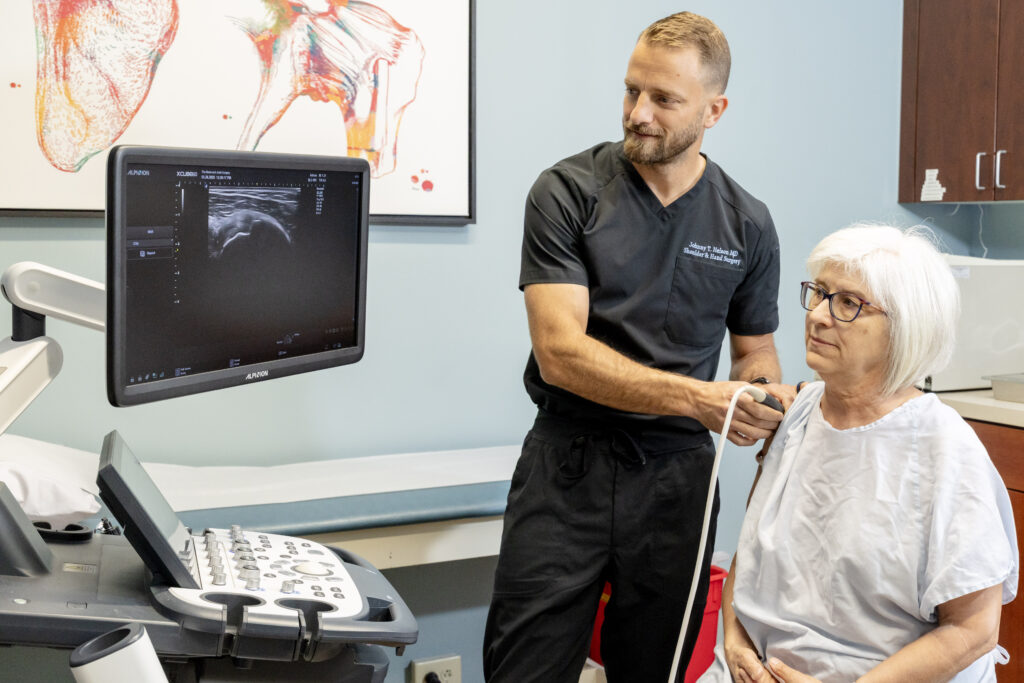
This is another reason why ultrasound is very helpful. Ultrasound can evaluate the structures of the shoulder during movement. The shoulder can also be re-positioned and structures can be looked at more closely with a simple movement of the ultrasound probe. Dr. Johnny T. Nelson, MD is the only fellowship trained shoulder specialist in the Raleigh Durham North Carolina area that uses ultrasound during clinic visits to evaluate the rotator cuff and other structures in the shoulder.

Because MRI studies can miss tears and other problems in the shoulder, there are situations where patients decide to move forward with a shoulder scope procedure even though very little is found on the MRI. Often in these situations, sizable tears are found in the rotator cuff, even though the MRI was normal! This is well-documented in the medical literature.

If you have had an MRI study of your shoulder and would like to have Dr. Johnny T. Nelson, MD review the MRI and examine your shoulder, call 919-872-5296 today to schedule a visit with North Carolina’s rotator cuff repair specialist!


My Shoulder MRI Is Normal. Could There Still Be Something Wrong? Read More »

Why Is It Important for a Shoulder Specialist to Use Ultrasound?

Why Is It Important for a Shoulder Specialist to Use Ultrasound?

If you are reading this, it is likely that you or someone you know has shoulder pain. It is possible that you tried treatments to improve your shoulder pain without success and are considering a visit with an orthopedic shoulder specialist.

This is certainly a good place to start.

An orthopedic shoulder specialist is expert in the evaluation, diagnosis, and treatment of all shoulder problems including rotator cuff tears, bursitis, instability, and biceps problems. An orthopedic specialist can order and read x-rays, CT scans, MRI studies and has more in-depth knowledge of the shoulder and shoulder problems than any other healthcare provider, including primary care physicians, physical therapists, chiropractors, and nonsurgical sports medicine doctors. Not only can an orthopedic shoulder specialist evaluate your shoulder, but they also provide treatment. It is also important to know that a visit with an orthopedic shoulder specialist does not always mean you will have surgery.

But there are many options out there! It is important that you see a shoulder specialist that uses ultrasound as part of evaluation and treatment of shoulder pain.

If you live in North Carolina, you are in luck! Dr. Johnny T. Nelson, MD is one of those shoulder specialists!

At The Bone and Joint Surgery Clinic, Dr. Johnny Nelson has state-of-the-art ultrasound equipment that allows a high-resolution scan of the rotator cuff and other structures in the shoulder. Along with a physical exam, x-rays, and a short discussion, Dr. Nelson can give you important information about the cause of your shoulder pain.

Doctors that do not use ultrasound are not able to see or evaluate the rotator cuff at the time of evaluation. This often requires an MRI study, which insurance companies will often deny, are expensive, require complicated scheduling, and multiple other visits to obtain. As a result, patients with big rotator cuff tears may possibly be treated with physical therapy, injections, or observation when they should be undergoing rotator cuff repair.

Dr. Johnny T. Nelson is also able to use ultrasound to perform targeted injections that are not possible without ultrasound. These include biceps injections and suprascapular nerve injections, which can be very helpful and more effective than “traditional” blind injections performed without ultrasound.

Do you have shoulder pain? Are you worried that you have a rotator cuff tear? Call 919-872-5296 today to schedule a visit with Dr. Johnny T. Nelson, MD, Raleigh North Carolina shoulder specialist.

Why Is It Important for a Shoulder Specialist to Use Ultrasound? Read More »

Screenshot 2024 02 27 at 11.22.26 AM

How Long Do I Have to Wear A Sling After Rotator Cuff Repair?

Screenshot 2024 02 27 at 11.22.26 AMHow long do I have to wear a sling after rotator cuff repair?

You recently discussed rotator cuff repair with your orthopedic shoulder specialist and you are moving forward with repair. Hopefully you are seeing a talented specialist. A talented specialist will spend time with you and discuss the details of the after-surgery healing process.

One of these details is the use of an arm sling after your rotator cuff repair.  After rotator cuff repair, your arm will be immobilized in an arm sling, sometimes called a “UltraSling.”  It usually consists of a durable, high-quality, well-padded sling. It also has an extra “pillow” piece that will help keep your arm and elbow from moving too much.

For more information on use of your sling, see Dr. Nelson’s YouTube channel. You may also download and print this important document, Shoulder Arthroscopy: What You Need to Know. Or you may visit Dr. Nelson’s main rotator cuff repair page.

After surgery, the rotator cuff repair must be protected.  If your arm hangs free, the movement in the early weeks after the surgery will be uncomfortable. However it also places too much stress and tension on the rotator cuff repair.  If too much stress and tension is placed on the rotator cuff repair, there is a risk that the repair will come loose and fail.

The sling also serves as an important reminder.  It reminds you as a patient that you should not be using the arm, and it reminds others around you that you had surgery and should not be expected to use the arm.

But how long do I have to wear the sling?


The answer to this question is different for different doctors.  Dr. Johnny T. Nelson follows a very simple protocol.  Rotator cuff repair patients will need to wear their sling full-time for 4 weeks after the procedure.  Of course, Dr. Nelson will have you come out of the sling for simple hand, wrist,  and elbow exercises and sometimes some very gentle movement exercises of the shoulder. However you will be wearing your sling 24 hours per day, including sleep. After 4 weeks, Dr. Nelson will permit you to remove the sling while at home only and use the arm for very gentle activities

Dr. Johnny T. Nelson will still have you wear the sling when you leave the house up until 6 weeks after surgery.  This is because it is important that you do not use the arm to do things like open doors, drive a car, carry grocery bags, etc.

In the first 4 weeks, there are a few reasons to remove your sling.


For example, if you are taking a shower or getting dressed, it is necessary to remove your sling.  In these situations, it is still important to be careful with the arm and not use it for grasping, pushing, or pulling, or lifting.

It is also okay to remove your sling if you are sitting or lying down, such as on a sofa or armchair. It is acceptable to remove the straps and remove the sling for comfort, allowing the arm to rest at your side.  You may do this only if you are awake.  Remember, the sling is a reminder above all else, which is most important when you are up and especially when you are out of the house.

If Dr. Nelson does not perform a rotator cuff repair, and shoulder surgery targets other problems (such as the biceps tendon or bone spurs), he may allow you to remove your sling earlier and begin using your arm earlier.

If you have shoulder pain, if you have a rotator cuff tear, if you are in need of an orthopedic shoulder doctor, call 919-872-5296 today to schedule your visit with Dr. Johnny T. Nelson, MD.

How Long Do I Have to Wear A Sling After Rotator Cuff Repair? Read More »

Book An Appointment

* All indicated fields must be completed.
Please include non-medical questions and correspondence only.

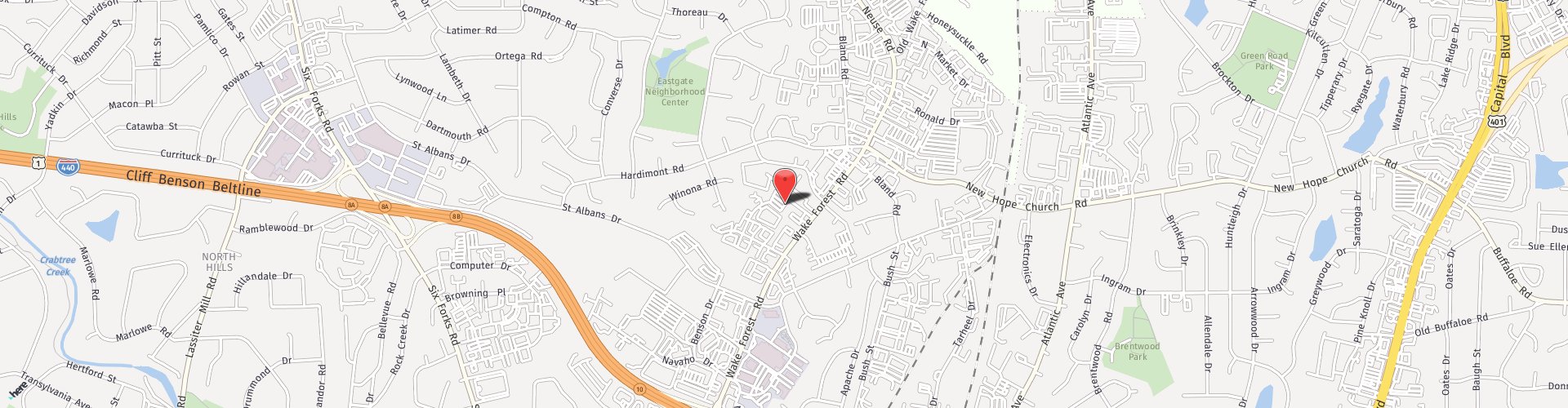
Location Map: 3801 Wake Forest Road Raleigh, NC 27609
rue logo wt

OFFICE HOURS

Monday - Friday: 8:30 am - 4:30 pm

CONTACT US

Accessibility Toolbar

Scroll to Top